

The Brand Strength Measurement (BSM) Index is a qualitative, non-financial evaluation model that is designed to measure a brand’s ability to deliver on its promise to consumers. It assesses brand strength using key consumer decision drivers, including visibility, perception, leadership, and societal relevance.
The Most Valuable Asset
The brand has become one of the most valuable assets of any corporate organization. Beyond physical infrastructure and financial capital, a strong brand influences consumer’s choice, it commands loyalty, influences culture, and sustains long-term relevance. For an intangible asset that drives choice, loyalty, and future earnings, a brand deserves to be periodically and rigorously evaluated to ensure relevance.
The strength of a brand is no longer defined only by size, age, or financial performance in today’s highly competitive marketplace; strong brands live in the minds of consumers, dictates the market tones and enjoying the benefit of natural preference over alternatives.
This post is a holistic overview of the thinking, structure, and depth of work behind the Brand Strength Measurement (BSM) Index, the proprietary model used to evaluate and rank Nigeria’s top corporate brands annually.
It is intended to help brand leaders to clearly see what it takes to emerge as one of the country’s strongest brands.
What BSM Does
The BSM Index measures brand strength from the consumer’s point of view, not from the boardroom and the stock market. In line with global brand evaluation standards, the BSM Index isolates brand strength from financial performance.
This approach is deliberate, because consumers ultimately decide which brands are:
- trusted
- chosen
- remembered
- defended in moments of crisis
By basing the evaluation on consumer perception, which is validated with informed industry insight, the BSM Index captures the real-world power of a brand in the marketplace.
It is important to note that the BSM Index is not a monetary or financial valuation of brands. While financial performance is a common way of measuring value, it is only one of many valid approaches.
Value can also be evaluated through non-financial indicators that reflect achievement, quality, capability, and relevance. These indicators often serve as leading signals of brand health, while financial outcomes remain lagging results.
What the BSM Index Represents
The BSM Index does not ask, “Which brand makes the most money?” Rather, it asks, “Which brands are strongest in the minds and lives of consumers?”
Accordingly, it measures:
– Awareness and recall
– Consumer engagement
– Trust and sentiment
– Leadership and relevance
– Quality of delivery
– Societal connection
These are the foundations of enduring brand value.
The Seven Pillars of the BSM Model
- Popularity (Top of the Mind Awareness)
This measures spontaneous brand recall through a Top of the Mind (TOM) survey, where respondents were asked to mention brands without prompts. The survey includes both consumers and senior marketing leaders such as CMOs and Heads of Corporate Communications, ensuring balance between market perception and industry insight.
It’s important to note that Popularity carries the highest weight in the BSM model, as brands that are not recalled are rarely considered. Empirical observations overtime shows that consumers most often recall brands they trust, engage with, patronize consistently.
- Online Engagement
This evaluates a brand’s digital footprint, including the quality of its corporate website, its search visibility, media mentions, and social media engagement. In our world that is now digital-first, online credibility plays a critical role in shaping trust and choice.
- Sentiment Analysis
Sentiment Analysis measures how people talk about a brand across the media and public discourse over a defined period of time. It assesses the overall tone of the coverage as positive, neutral, or negative.
- Category Leadership
This pillar evaluates a brand’s influence and standing within its primary industry, based on market share and leadership perception in comparison with competitors. Top brands often have larger market share and influence in their industry.
- Customer Service, Innovation & Quality
This important pillar assesses delivery excellence across products, services, and communications, including service quality, innovation, and relevant regulatory or quality certifications.
- National Presence
National Presence measures a brand’s operational reach and penetration across the country. Brands are expected to have substantial national footprints, with operational presence in a minimum of half of the country’s states or across four of the six geopolitical zones to be considered a truly strong national brand.
- Corporate Social Responsibility (CSR)
CSR evaluates how brands connect with the society through sustainability initiatives, social impact, and community development efforts. Strong CSR performance strengthens emotional affinity and deepens consumer connection with the brand.
The BSM Model
The BSM Index is defined as a weighted linear aggregation of seven normalized brand-performance variables, where the assigned weights reflect the relative importance of each variable in consumer decision-making.
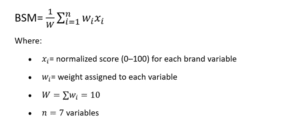
This structure ensures that the final BSM Index is standardized on a 100-point scale.
The Brand Strength Measurement (BSM) Index also aligned structurally and conceptually with global brand evaluation standards by separating and evaluating brand strength as a distinctive construct. While international models may subsequently translate brand strength into financial value, the BSM Index deliberately keep to a non-monetary focus, such that provides a clear, consumer-focused benchmark of brand performance and resilience within the Nigerian market.
Exclusions and Ethical Considerations
For ethical, moral, and public health reasons, the evaluation excludes governmental, politically aligned, religious, NGO, tobacco, and betting brands.
TOP 50 BRANDS NIGERIA® Benchmark
The TOP 50 BRANDS NIGERIA® ranking, which has become a report card for major corporate brands in Nigeria is not just a list; it is a benchmark for brand excellence. Behind every ranked brand is years of consistency, investment, innovation, and consumer trust that has earned them strong affinity.
The Brand Strength Measurement (BSM) Index recognizes that work fairly, rigorously, and from the consumer’s point of view.